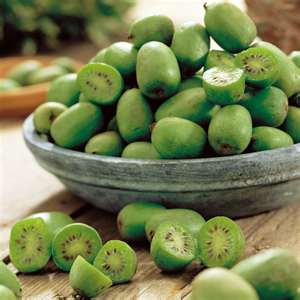
At first glance kiwi fruit (Actinidia deliciosa) is similar sapodilla fruit. Brownish skin color with fine hairs on the entire surface. Green flesh with smooth seeds in the middle. It was sweet, fresh sour, ideal served as a table or created juice.
Kiwi fruit known as the largest producer of vitamin C among other fruits. A unique form of fruit, hairy fruit with a distinctive texture, making kiwi granis or decoration used as food.
Fruit from China was introduced to New Zealand in 1906 and the type began to be developed until the New Zealand kiwi known as the producing countries, there are currently around 10 species of kiwi are grown almost all over the world including in the United States, France, Italy, Spain, Israel, Chile, Australia, South Africa and Russia.
Kiwi is a good quality are usually picked when ripe, but the texture is dense. When pressed with a finger, kiwi fruit feels solid but not hard. The fruit is too soft, usually foul. Large size are not indicative of good quality kiwi. Kiwi taste will be sweeter if left to mature at room temperature.
Prices are expensive to make kiwi rarely consumed directly. But at least, kiwi can be added to the various preparations that are very popular with your family. If in season, the kiwi is very easy to find at a price not too expensive. But if not the season, do not expect to find a kiwi in the supermarket.
kiwi usually processed into a pudding or a refreshing beverage. In the presentation of international foods, the kiwi is more often used as granis who also serves as stuffing the food, like fruit salad.
Better to eat kiwi when it is fresh because it has not gone away kandungann nutrition. Fresh kiwi can be eaten directly by way of cut or scooped straight. Or it could also be mixed in cereal, yogurt, ice cream or fruit sorbet. In another dish such as cake, Bavarian cream pie and kiwi increase appetite because of its fresh.
In areas of Europe, often processed denagn kiwi mixed in cooking meat, poultry or fish. Often also used in making sauces and soups.
Like most fruits, the kiwi is the highest content of water is about 83% by weight. The content of many others who also are carbohydrates (15 grams), protein (1 g), fat (0.4 grams), fiber (3.4 grams) and calories (61 kcal), for every 100 grams of kiwi.
Kiwi source of vitamin C and potassium are the best, but it also contains magnesium, phosphorus, iron, and vitamin A. Kiwi produce vitamin C two times more than oranges and lemons, until it can be said, kiwi can prevent bone disease crooked.
New Zealand is the country's largest producer of kiwifruit in the world, but it is actually not a fruit kiwi fruit native country New Zealand, according to a story kiwi fruit originated in China and then brought by the British and developed here. But really the fruit came from China? According to Food by Waverly Root, there is no literature that mentions that China's growing kiwi fruit. In fact, Bangladesh is referred to as country of origin of kiwifruit, not from China like the Latin name.
Super Fruits Kiwi : Tiny but mighty This is a good source of potassium, magnesium, Vitamin E & fibre. It's Vitamin C content is twice that of an orange. Apple : An apple a day keeps the doctor away? Although an apple has a low Vitamin C content, it has antioxidants & flavonoids which enhances the activity of Vitamin C thereby helping to lower the risks of colon cancer, heart attack & stroke.
Strawberry : Protective Fruit Strawberries have the highest total antioxidant power among major fruits & protect the body from cancer causing, blood vessels clogging free radicals.
Orange : Sweetest medicine Taking 2 -4 oranges a day may help keep colds away, lower cholesterol, prevent & dissolve kidney stones as well as lessen the risk of colon cancer.
Watermelon : Coolest Thirst Quencher Composed of 92% water, it is also packed with a giant dose of glutathione which helps boost our immune system. They are also a key source of lycopene - the cancer fighting oxidant. Other nutrients found in watermelon are Vitamin C & Potassium.
Guava & Papaya : Top awards for Vitamin C They are the clear winners for their high Vitamin C content. Guava is also rich in fibre which helps prevent constipation. Papaya is rich in carotene, this is good for your eyes. Tips of how to stay young....... . Research has found that people who generally live longer do so partly because of good habits. Here, Dr Vernon Coleman and others provide some of the following good habits for longevity.
1) Laugh & fun, don't be gloomy
2) Let bygones be bygones. Dwelling on the past inflicts unnecessary stress.
3) Early to bed, early to rise, is healthy & wise
4) Stay lean, being just 30% overweight is bad.
5) Keep learning, reading & socializing - an alert & active mind keeps brain cells healthy.
6) Keep working, doing something you like. Don't retire, it slows down your body.
7) Be the boss of your own life. Letting others push you around produces stress.
8) Too many pills ruin your body, take just what you need.
9) Constantly alternating between weight gain & loss is bad
10) Exercise, quit smoking and eat less fatty foods
11) Do not worry about health & death, just get on with your life and enjoy it.